Can a Meniscus Tear Heal Without Surgery in St. Paul?
Many meniscus tears can heal or become pain-free without surgery, especially small, stable, or degenerative tears and tears in the outer “red zone,” which has a good blood supply. Physical therapy restores knee strength, mobility, and stability so most people return to activity in about 6 to 12 weeks. In St. Paul, MN, expert knee pain physical therapy and manual therapy guide recovery. Book an evaluation today.
What Is the Meniscus?
Each knee has two C-shaped pieces of cartilage called menisci: the medial meniscus on the inside and the lateral meniscus on the outside. They sit between the thighbone (femur) and shinbone (tibia), absorb shock, spread load across the joint, and help keep the knee stable.
What Causes a Meniscus Tear?
- Acute tears: twisting or pivoting on a planted foot in soccer, basketball, hockey, skiing, or football
- Degenerative tears: gradual wear that makes the meniscus fray, often after age 40, sometimes from simple squatting or kneeling
- Combined injuries: meniscus tears commonly occur alongside an ACL tear
Who Is Most at Risk?
- Athletes in cutting and pivoting sports such as soccer, basketball, hockey, and football
- Adults over 40, as the meniscus becomes less flexible with age
- People whose jobs involve frequent kneeling or deep squatting
- Anyone with a previous knee injury, ACL tear, or weak quadriceps and hip muscles
Meniscus Tear Symptoms
- Pain along the inside or outside joint line of the knee
- Swelling and stiffness that develop over 24 to 48 hours
- Catching, clicking, or popping during movement
- Difficulty fully straightening or bending the knee
- A feeling that the knee gives way
- True locking, where the knee gets stuck and cannot straighten
Can a Meniscus Tear Heal Without Surgery?
Often, yes. Whether a tear heals depends on its location, type, size, and your age and activity level.
Tears that often do well without surgery:
- Small or stable tears
- Tears in the outer third of the meniscus (the “red zone”) with good blood flow
- Degenerative tears in middle-aged and older adults
- Tears that do not cause the knee to lock
Tears that may need a surgical consult:
- Large bucket-handle tears that cause locking
- Tears in the inner “white zone” with mechanical symptoms that do not improve
- Meniscus tears combined with an ACL rupture in athletes who pivot and cut
Research comparing physical therapy with arthroscopic surgery for degenerative meniscus tears has found similar long-term results for pain and function in many patients. Even when the tear itself does not fully heal, strong muscles and good movement mechanics can make the knee pain-free. Physical therapy is usually the recommended first step unless the knee is locked or another serious injury is present.
How Physical Therapy Treats a Meniscus Tear
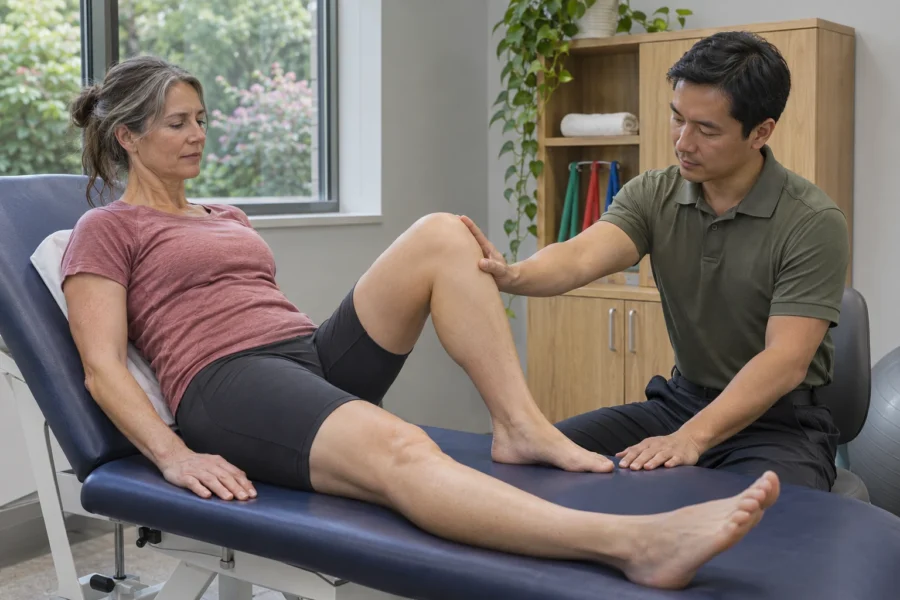
At LAB Sports Therapy in St. Paul, your plan starts with a Physical Therapy Evaluation of knee motion, swelling, strength, balance, and how you move during squats, stairs, and sport.
Typical phases include:
- Calm the knee (weeks 0 to 2): swelling control, gentle range of motion, and quad activation
- Restore motion and strength (weeks 2 to 6): progressive quad, hamstring, hip, and calf strengthening, plus hands-on manual therapy
- Build stability and control (weeks 6 to 10): balance work, single-leg strength, and controlled squatting and lunging
- Return to sport (weeks 8 to 12+): running, jumping, cutting drills, and return-to-sport testing
Dry needling may help tight quads, hamstrings, or calves that change how the knee loads. Our injury prevention training then lowers the risk of a repeat injury.
Meniscus Tear Recovery Time
- Non-surgical rehab: about 6 to 12 weeks for most people
- Partial meniscectomy (trimming): often 4 to 8 weeks to return to activity
- Meniscus repair (stitching): usually 3 to 6 months before full return to sport
When to See a Physical Therapist
Book an evaluation if knee pain, swelling, or catching lasts more than a few days, or if you cannot return to training. Early rehab limits stiffness and muscle loss and helps decide whether imaging or a surgical opinion is needed.
Meniscus Tear Rehab in St. Paul, MN
Knee pain from a meniscus tear does not always mean surgery. Runners with knee pain may also be dealing with one of three common runner’s knee diagnoses, which our knee pain physical therapy in St. Paul also treats. Our St. Paul physical therapy clinic serves St. Paul, Rosemount, and Minneapolis. Contact us for a free 15-minute injury consultation.