How Do Runners Recover From Achilles Tendonitis and Return to Running?
Achilles tendonitis in runners is an overuse injury that causes pain and stiffness in the tendon above the heel, usually from sudden mileage increases, hill work, tight calves, or worn shoes. Physical therapy treats it with progressive calf loading, gait correction, and a graded return-to-running plan, and most runners recover in about 6 to 12 weeks. In St. Paul, MN, expert ankle pain physical therapy and dry needling speed recovery. Book an evaluation today.
What Is Achilles Tendonitis?
The Achilles tendon connects the calf muscles (gastrocnemius and soleus) to the heel bone. It is the strongest tendon in the body and absorbs several times your body weight with every running stride. Runners place more strain on it than almost any other athletes.
Achilles tendonitis, more accurately called Achilles tendinopathy, develops when the tendon is loaded faster than it can adapt. There are two main types:
- Mid-portion Achilles tendinopathy: pain and thickening about 2 to 6 centimeters above the heel, the most common type in runners
- Insertional Achilles tendinopathy: pain where the tendon attaches to the back of the heel, often aggravated by uphill running and tight shoes
Achilles Tendonitis Symptoms
- Pain and stiffness in the back of the heel or lower calf, worst in the first steps of the morning
- Pain at the start of a run that may ease, then return afterward
- Tenderness, swelling, or a thickened area along the tendon
- Pain with hopping, hill running, or climbing stairs
- A creaking or tight feeling when you move the ankle
What Causes Achilles Tendonitis in Runners?
- Increasing mileage, speed, or frequency too quickly
- Adding hills, speedwork, or track sessions
- Weak or tight calf muscles and limited ankle mobility
- Worn-out shoes or a sudden switch to lower-drop or minimalist shoes
- Running gait issues such as overstriding or excessive pronation
- Returning to running after a break without a gradual build-up
Many runners also deal with related problems such as shin splints and plantar fasciitis, which share similar training errors.
Achilles Tendonitis vs. Achilles Rupture
Tendinopathy builds gradually. A rupture happens suddenly and often feels like being kicked in the back of the heel, sometimes with a pop, followed by weakness pushing off or standing on tiptoe. A suspected rupture needs urgent medical assessment. Calf strength testing and a simple calf squeeze test help clinicians tell the two apart.
How Physical Therapy Treats Achilles Tendonitis
Tendons respond to the right load, not complete rest. At LAB Sports Therapy, your Physical Therapy Evaluation assesses calf strength, ankle mobility, hip and foot mechanics, and running form.
Your plan may include:
- Load management: reducing aggravating running without stopping all activity
- Isometric calf holds to calm pain early
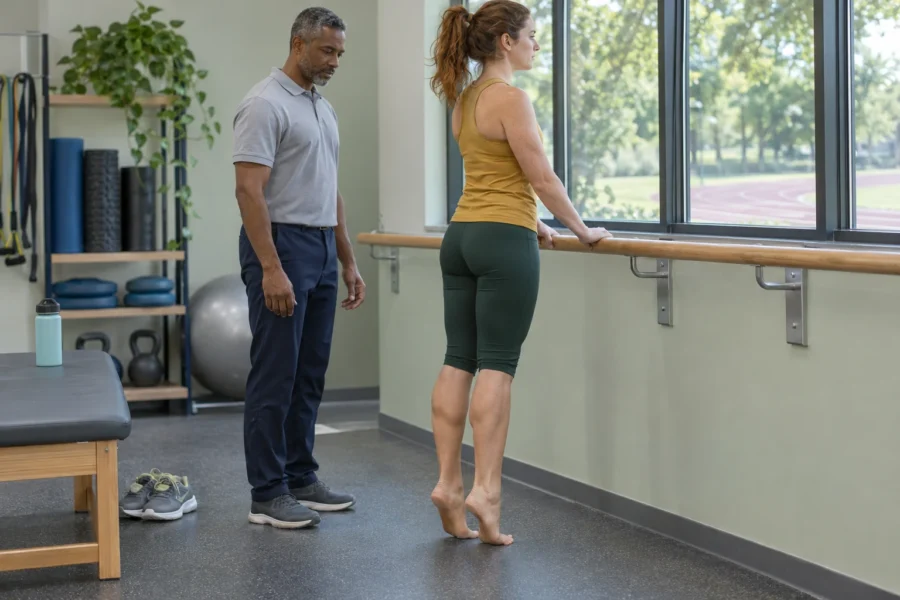
- Progressive calf strengthening: eccentric heel drops and heavy, slow calf raises on straight and bent knees
- Hands-on care and dry needling for tight calves and surrounding tissue, supported by manual therapy
- Running gait analysis: video gait analysis to correct overstriding and cadence
- Plyometric and hopping progressions to restore spring before full running
For insertional tendinopathy, exercises are often done on flat ground rather than off a step to avoid compressing the tendon at the heel.
Return to Running After Achilles Tendonitis
You are usually ready to start a walk-run program when you can do 20 or more single-leg calf raises and hop without significant pain. Mileage then builds gradually, with pain kept low during and the morning after runs. Our injury prevention programs and return-to-sport testing help you get back to racing with confidence.
How to Prevent Achilles Tendonitis
- Increase weekly mileage gradually and add only one new stress at a time, such as hills or speedwork
- Strength train your calves two to three times per week with single-leg calf raises
- Replace running shoes before they lose cushioning, and change shoe styles slowly
- Keep easy runs truly easy and build in recovery days
- Warm up before speed sessions with dynamic drills and short strides
Minnesota runners often see Achilles flare-ups in spring, when training ramps up after a winter of treadmill or reduced running. Planning a gradual build helps your tendons keep pace.
Achilles Tendonitis Treatment in St. Paul, MN
LAB Sports Therapy St. Paul helps runners across St. Paul, Rosemount, and Minneapolis recover from Achilles pain through ankle pain physical therapy in St. Paul and get back on the road and trails. Contact us for a free 15-minute injury consultation.